
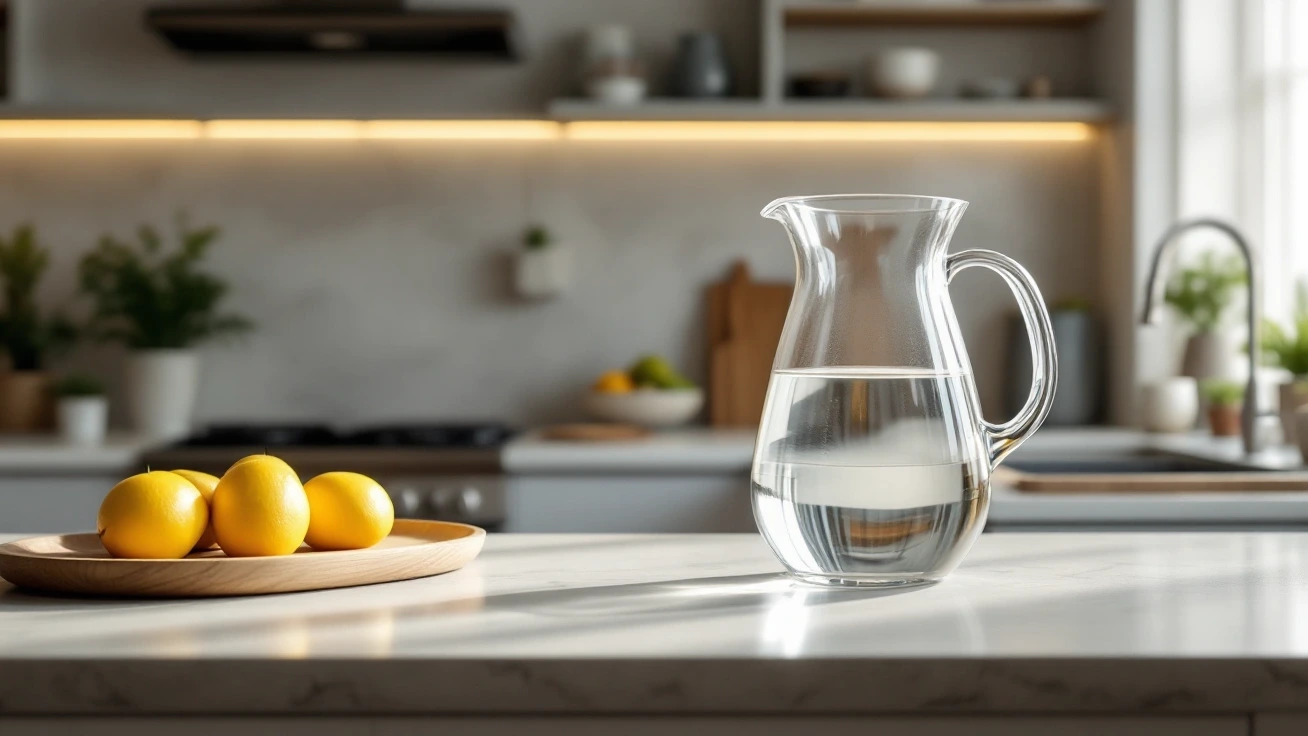
This AquaTru reverse osmosis review covers the Carafe with the standard carbon filter. It suits a small drinking-water task where you want to avoid plumbing work. The trade-off is daily handling. You'll fill the feed tank, empty the reject water and keep the carafe clean. Choose it for that routine, rather than for a whole-house water problem.

AquaTru CarafeAquaTru Carafe
Our verdict:
Glass-carafe serving format
A small drinking-water routine where a removable glass carafe is useful.
View on Amazon- Refillable countertop RO
- Removable glass carafe
- No fixed feed or drain plumbing
Keep in mind: Manual tank handling and separate filter schedules remain part of ownership.
How We Picked the AquaTru Carafe
We checked the exact listing record, the US Carafe page and the maker's setup guidance. This is a review of published data. We have not used or bench-tested the purifier. The choice rests on its format, its documented treatment claims and the work that comes with a refillable tank.
Keep the Carafe name separate from Classic and Under Sink. Even a close-looking filter can have different fittings or a different service schedule. Match the exact unit and cartridge codes when you buy replacements. A bundle with an alkaline filter is also a different choice from the standard carbon version reviewed here.
Who this AquaTru reverse osmosis system suits
The main reason to choose Carafe is to keep the treatment task on the counter. A renter may be unable to add a faucet or drain saddle. A small kitchen may have no useful space under the sink. In those cases a refillable unit can avoid changes to fixed plumbing, provided its feed water meets the manual.
It still takes up working space. Put a paper outline on the counter before ordering. Leave room to lift the feed tank and remove the carafe. Check the path to the sink too. A unit beside the sink has a different daily burden from one across a crowded room.
Skip this format if you want one system to treat every shower and appliance. Carafe treats the water you put through it. It cannot solve scale on all the pipes in a house. For that separate task, start with a water test and a whole-house treatment plan.
Carafe features and their practical limits
| Published feature | Why it may fit | Limit to check |
|---|---|---|
| Countertop, manually filled format | No fixed feed or drain plumbing | Refilling and emptying remain daily jobs |
| Removable glass carafe | You can take the finished water to the table | Glass needs careful handling and cleaning |
| Reverse osmosis treatment | A membrane forms part of the treatment train | Only exact listed reductions are established |
| Separate replacement filters | Each stage has its own service task | Cartridges must match Carafe, not another model |
Scroll for more →
These features describe the setup. They are not a score for every possible water concern. The NSF standards guide explains why the named standard and reduction claim matter. A filter badge should lead to an exact listing and performance sheet. It is not a claim that a system treats all substances.
Check the feed water before the kitchen layout
Start with the source. A municipal supply report gives useful context, but a concern about water at your own tap may call for its own sample. A private well needs a different assessment. Do not assume that an attractive countertop unit makes untreated well water suitable to drink.
Read the Carafe manual's feed limits before buying. Water outside a unit's permitted range may need pretreatment or a different design. Ask about hardness if scale is already a problem in the kettle. Do not carry a limit from Classic into Carafe because both use the AquaTru name.
A total dissolved solids meter, often called a TDS meter, does not identify each substance in the water. Use it only for the task the manual describes. A reading alone cannot confirm a named reduction or prove that the source is free of a microbial problem.
Refilling, reject water and first use
Reverse osmosis separates a stream of finished water from a reject stream. In a manually filled unit, that reject water needs handling. Follow the maker's drain-and-refill routine. Do not keep topping up the old feed water unless the instructions explicitly allow it.
Plan the routine around how you drink and cook. Fill a kettle, a bottle and a cooking pot in your usual order to estimate the water task. That is a planning exercise, not a performance test of Carafe. It tells you whether a batch process would fit the household before you buy one.
Use the current instructions for first-use flushing. Do not drink a commissioning batch that the maker says to discard. Keep the guide with the cartridge codes and installation date. A small record prevents confusion when a filter indicator appears months later.
Costs that the purchase price leaves out
Compare the correct filter set, not the cheapest bag of cartridges with a similar photo. Check what ships with the selected package. Then list future filters, cleaning supplies allowed by the manual and any replacement glassware you may want. We do not quote a fixed ownership price because those inputs change.
The appeal of avoiding plumbing work is real for the right home. It does not remove service costs or water use. An under-sink unit may suit frequent use better if a fixed installation is allowed. Use the RO installation guide to compare those fitting tasks.
For the wider choice of treatment formats, use the best reverse osmosis system guide. Match the required result before narrowing the equipment.
Frequently asked questions
Can Carafe replace a whole-house water filter?
No. Its task is to treat the water placed in its feed tank. Water used elsewhere does not pass through it. Keep drinking-water treatment separate from hardness removal, sediment at every tap or another whole-house concern. Each needs evidence about the source and the exact treatment you plan to install.
Does no plumbing mean no maintenance?
No. You still fill and empty tanks, clean the parts the manual names and replace filters on the specified schedule. Check access for each task before buying. A countertop unit can avoid fixed pipe work while still asking for more daily handling than a permanently plumbed drinking-water system.
Are all AquaTru cartridges interchangeable?
Do not assume so. Match the model and cartridge code to the current Carafe manual and replacement listing. The brand sells more than one purifier format. A cartridge that fits Classic or Under Sink is not a suitable substitute just because its name or packaging resembles a Carafe part.
Should I choose the alkaline version?
Treat that as a choice about the exact finishing filter and your preference for the water. This review does not claim a wellness benefit. Compare the standard and alkaline filter codes, their listed claims and future replacement needs. Do not transfer one version's evidence to the other without checking it.
Verdict on AquaTru reverse osmosis
The AquaTru reverse osmosis Carafe is worth shortlisting for a modest drinking-water task where fixed plumbing is awkward. The removable glass carafe is useful, but daily filling and cleaning are part of the choice. Check feed limits and exact filter parts first. Then decide whether that routine fits better than an installed under-sink unit.